Licence No. 387609C
Overhead power lines are easy to ignore until something looks wrong. A line starts to sag, insulation appears worn or a tree branch is pushing against the wires, and suddenly there is a real question about safety. Fraser Electrical helps homeowners understand when an overhead line issue may be more than a minor concern and when it is time to call an emergency electrician in the Central Coast to prevent serious risks to people, property and power supply.
This article explains the warning signs that suggest an overhead line may be damaged or unsafe, what immediate steps to take to protect yourself and others, and when to contact the electricity distributor or a licensed electrician. It also outlines common causes of overhead line problems such as storm damage, corrosion and vegetation growth, and clarifies what you may be responsible for on your property. By understanding these points, it becomes easier to act quickly, avoid dangerous DIY decisions and make sure the right professionals are involved before the situation worsens.
When an overhead power line looks damaged, sagging or unsafe, the situation should be treated as an electrical emergency. Acting quickly and correctly reduces the risk of electric shock, fire or serious injury to anyone nearby.
The safest approach is to assume every power line is live and dangerous, even if it appears broken, is not sparking or the power in the property is already off. The steps below outline what to do immediately and what must be strictly avoided.
If a power line looks damaged, is on the ground or is in contact with trees, a roof or a vehicle, keep everyone away from the area. As a general safety guide, stay at least 8 to 10 metres away from the line itself and anything it touches, or further where possible. Electricity can travel through the ground, fences, branches and metal structures even if there is no visible sign of danger.
Call the local electricity distributor or emergency number at once and clearly describe what is seen. Provide the exact location and explain any visible damage, such as sparks, smoke, a fallen line or a line touching a building, tree or vehicle. If there is immediate danger to life or fire, contact emergency services first.
If it is safe to do so without approaching the line, warn neighbours and passers-by to stay away until the area is made safe. Block access with visible barriers such as bins, cones or garden furniture placed well back from the danger area rather than going closer to the line.
If a vehicle is in contact with a power line and people are inside, advise them to stay in the vehicle with doors closed and hands in their lap until help arrives. The vehicle often provides a safer barrier than stepping out onto the ground. Only if there is fire or immediate life-threatening danger should occupants attempt to leave, and then only by jumping clear with both feet together and shuffling away without lifting their feet apart to reduce step potential.
Do not touch the power line under any circumstances, even if it appears insulated or broken. Do not touch anything in contact with the line, such as tree branches, roofing, metal gutters, fences or vehicles. Electricity can travel through these materials and cause serious or fatal shock.
Do not attempt to move or secure a damaged line with tools, ladders, ropes or poles. Even so-called non-conductive tools can become a path for electricity if they are wet, dirty or used too close to live equipment.
Avoid walking or driving over a fallen line. If a line is across a driveway or road, stay back and keep others away until the network operator or emergency services arrive.
Do not attempt DIY repairs to nearby electrical systems, such as meter boxes, service lines attached to the house or connection points, when an overhead line appears damaged. Disturbing associated equipment can change how electricity flows and increase danger.
Finally, do not assume that a line is safe because the power in the property is out or because there is no visible arcing. Lines can be re-energised without warning and may remain live even when they are quiet and still.
Recognising early signs of damage on an overhead power line is critical to prevent electric shock, fire or power interruptions. Many issues are visible from the ground if attention is paid to the poles, wires and surrounding area. Any suspected problem should be treated as dangerous until a qualified electrician or the network provider confirms it is safe.
The following signs indicate that a power line or its supporting equipment may be compromised and require urgent professional attention. Never approach the line or attempt to inspect it closely.
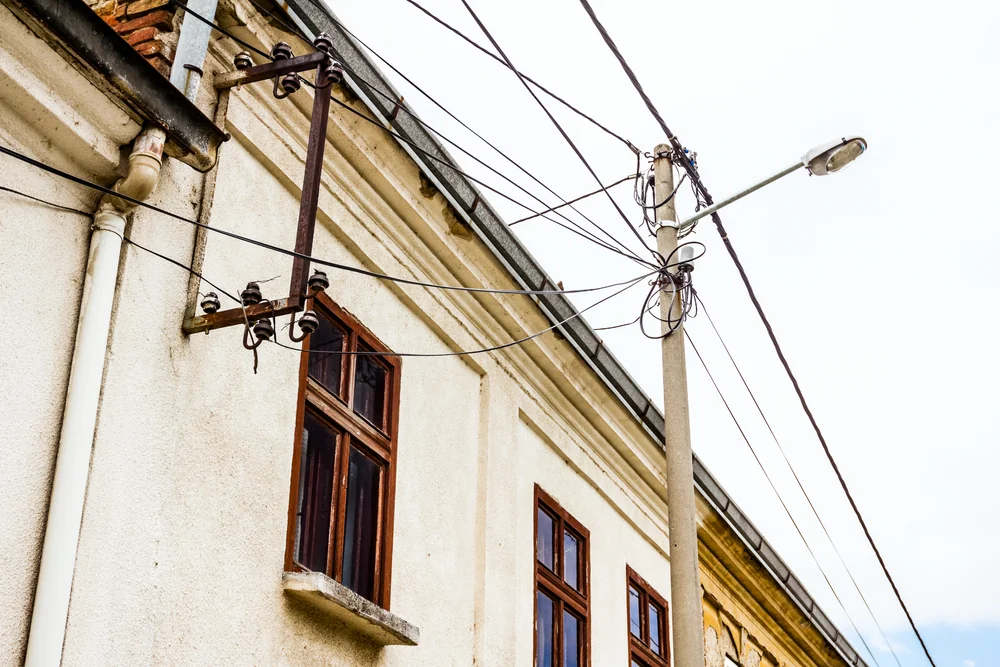
Obvious physical damage is one of the clearest warning signs. Look from a safe distance for wires that appear:
Insulators and fittings that hold the lines to the pole should look intact and secure. Cracked ceramic or glass insulators, loose metal brackets or hardware hanging at an angle suggest the support system has failed and the line may be live but unstable.
Any wire on the ground, across a roof or touching a fence must always be treated as live. The same applies to service lines that appear to be resting on verandas, sheds or trees instead of being fully clear and suspended.
Supporting structures in poor condition are just as dangerous as damaged wires. Signs that a pole may be unsafe include:
Concrete poles with spalling, exposed reinforcing steel or large chips at the base can lose strength and become unstable. Timber poles with heavy termite damage or extensive fungal decay are at risk of collapse, which can bring live wires down without warning.
Stay alert for signs that the ground around the pole has shifted, such as sinkholes, washouts or recent excavation. Disturbed soil can reduce support and allow the pole to tilt or fall.
Electrical faults often give audio or visual warnings before complete failure. Any of the following should be treated as an emergency:
These symptoms can indicate loose connections, damaged insulation or vegetation contacting live conductors. In dry or windy conditions, arcing on overhead lines significantly increases the risk of fire spreading to nearby vegetation, roofs or fences. If any of these signs are present, keep well clear, warn others away and arrange immediate professional attendance.
An overhead service line is the final link that brings electricity from the street network to a property. It may look like just “the power line to the house,” but it performs several critical functions for safety, reliability and billing. Understanding what it does makes it easier to recognise when something may be unsafe or in need of professional attention.
Although different properties can have slightly different configurations, the basic job of an overhead service line is always the same. It delivers electricity at the correct voltage to the point where it can be safely metered and then distributed through the building’s wiring.
The overhead service line usually starts at the nearest power pole on the street. From there, it runs across the street or boundary to the attachment point on the building. This short span bridges the gap between the electricity distributor’s network and the individual supply.
In a typical setup, the service line carries the following:
In many areas, a single bundled cable is used which contains all the required conductors. Older installations may have several separate wires instead. The number and arrangement of these conductors determine whether the property has single-phase or three-phase supply, which affects how much load the installation can support.
At the building, the service line usually connects to the following:
The point of attachment carries the mechanical load of the cable and must be strong enough to hold it under wind and weather. The service fuse or service protection device is often mounted near the meter and provides fault protection at the entry point.
After the meter, the wiring becomes part of the consumer mains that feed the main switchboard. From the switchboard, power is divided into individual circuits for lights, power points, hot water, air conditioning and other loads. Proper operation of the overhead service line is essential for the meter to record usage accurately and for the switchboard safety devices to operate correctly.
The overhead service line is not only a delivery path for electricity. It also forms part of the electrical safety and earthing system.
The neutral conductor often provides the reference point for the property’s earthing system. If the neutral or service line is damaged, the following risks can occur:
Insulation on the service line prevents contact with live parts. Correct height and clearances keep it safely away from vehicles, people, trees and structures. When any part of this system is compromised, such as low sagging lines, damaged insulation or loose attachment hardware, the safety role of the overhead service line is reduced and professional inspection is required.
Responsibility for a damaged or unsafe overhead power line depends on where the fault is and which part of the electrical installation is affected. In most cases, the power distribution company is responsible for network equipment up to the official point of supply or connection point, while the property owner is responsible for private poles, consumer mains and electrical assets on the customer’s side of that point.
Understanding this boundary is essential before arranging repairs. Misunderstanding it can lead to dangerous delays, unnecessary costs and, in some situations, a longer interruption to the property’s power supply.
The local electricity distributor is typically responsible for network assets that form part of the public electricity supply. This usually includes:
If a tree has brought down lines in the street or a pole is leaning or broken on public land, it is normally a distributor issue. The same applies if the line between the street and the property appears damaged at the street end or there is visible damage to the network pole.
Any incident involving lines on the roadway, footpath or public land must be reported to the distributor’s faults or emergencies line and to emergency services if there is immediate danger such as arcing, smoke or fire. The distributor will arrange isolation, repairs and restoration of supply where the issue involves its network assets.
The property owner is usually responsible for electrical assets on private property beyond the official point of supply or connection point. Depending on the property and the distributor’s connection arrangement, this may include:
If a private pole is rotted, leaning or cracked, or its crossarm or insulators are damaged, the owner must engage a licensed electrical contractor to assess and arrange any required repairs or replacement. Likewise, if a private overhead line is sagging within the property boundary or insulation is visibly deteriorated, the cost of rectification generally sits with the property owner.
Failure to maintain private poles, private overhead lines and consumer mains can result in disconnection if a distributor or safety inspector identifies an immediate hazard.
In some situations, the point of supply can be difficult to identify, particularly in older properties, shared driveways or rural blocks with multiple poles. If there is any uncertainty, the safest approach is to:
The distributor and the attending electrician can confirm where responsibility lies so that repairs proceed without dispute or delay.
A damaged or unsafe overhead power line often calls for a specialist rather than a general electrician. In New South Wales, work that involves the electrical network itself, the point where supply connects to a property or metering equipment may need to be carried out by a Level 2 Accredited Service Provider, also known as a Level 2 ASP. Knowing when this is legally required helps avoid delays, safety risks and rejected work.
A Level 2 electrician is authorised to work on or near the Ausgrid or Endeavour Energy network, including certain service lines to a home or business. This can cover disconnections, reconnections, new connections, upgrades and repairs to the supply line from the street to the property.

A Level 2 electrician must be engaged whenever the incoming supply from the street is affected or needs alteration. Typical scenarios include:
Any situation where the supply must be disconnected at the street, or where new overhead cables need to be installed from the network to the building, also falls within Level 2 work.
Level 2 electricians hold specific accreditation to operate near the point of attachment, work within approved clearances of live network assets and install or replace certain service equipment, including service fuses and meters. General electricians are not permitted to carry out these tasks unless they hold the required accreditation, and network operators may refuse to energise non-compliant or unaccredited work.
When an overhead line looks unsafe, it is critical not to touch cables, poles or hardware, or attempt temporary repairs. The correct sequence is to stay clear, keep others back, call the network emergency number if there is arcing, smoke, fire or a fallen line, and then arrange attendance by a Level 2 electrician once the immediate hazard is controlled.
Many property owners are unsure where the responsibility of the network ends and private wiring begins, particularly around the fascia, roofline, private pole or meter box. As a practical guide, if the issue involves the following, it should be treated as Level 2 work:
Seeking advice from a Level 2 electrician early prevents unsafe DIY attempts, service disconnection by the network and costly rework if non-compliant alterations are made.
Understanding what typically harms overhead power lines helps identify when a hazard might be developing. Most visible problems can be traced to a handful of recurring causes, many of which are linked to weather, vegetation and ageing infrastructure. Recognising these patterns makes it easier to describe what is seen when reporting a concern and to understand why a situation might be urgent.
Damage is not always obvious, such as a snapped wire on the ground. Sagging lines, leaning poles or scorched marks on fittings can all indicate underlying issues caused by the factors outlined below. Any suspected damage should be treated as potentially live and dangerous.
High winds, heavy rain and storms are among the most common causes of overhead line damage. Strong gusts can cause conductors to clash together, leading to sparks, burn marks or weakened sections of wire. Wind can also stress connections at insulators and crossarms, which may later crack or fail.
Lightning strikes can damage insulators, hardware and transformers mounted on poles. Signs may include chipped or shattered insulators, blackened areas around fittings or equipment that appears charred.
Prolonged rain, flooding and saturated ground can undermine pole foundations. A pole that begins to lean, move at the base or show cracking in the surrounding soil may be at risk of collapsing. Coastal or high-moisture environments also accelerate corrosion of metal components, which can eventually weaken brackets, bolts and stay wires.
Heatwaves can cause lines to expand and sag lower than normal. Excessive sagging, especially where lines hang close to roofs, balconies, trees or vehicles, is a key warning sign that clearances may no longer be safe.
Trees growing too close to power lines are a significant source of damage. Branches rubbing against conductors in the wind can wear away insulation on covered lines or damage the outer surface of bare conductors. During storms, larger limbs or entire trees can fall onto lines, leading to broken conductors, snapped crossarms or poles brought down under the weight.

Overgrown vines or climbing plants can also pull on cables and hardware. Dense growth around poles can hide decay, leaning or cracked bases, making it harder to spot a developing fault.
Vehicle strikes are another frequent cause of damage. Trucks, farm machinery or tall loads may snag low lines or strike poles. Signs include fresh impact marks on poles, broken stay wires, skewed crossarms or lines that suddenly appear lower or twisted.
Construction activity and excavation near pole bases or stay anchors can disturb structural supports. If the ground has been recently dug or compacted around a pole and it now appears out of alignment, this can indicate compromised stability.
Over time, timber poles can rot at the ground line or higher where water collects. Indicators include soft or crumbling wood, visible decay at the base or fungal growth. Metal poles and fittings can rust, particularly near coastal areas or where road spray is common, leading to weakened structural parts.
Insulators and crossarms can become brittle with age and UV exposure. Cracked, chipped or discoloured insulators and warped or split crossarms can eventually fail and allow lines to drop or contact other hardware.
Connections and splices in conductors can loosen with years of thermal expansion and contraction. This may show as hot spots, discolouration or visible arcing marks. Any humming, buzzing or visible sparking from overhead equipment is a serious sign of possible component failure and should be reported immediately.
If an overhead power line looks damaged or unsafe, treat it as an emergency hazard, not a DIY repair. Sagging lines, damaged insulation, arcing, burning smells, leaning poles or recent storm damage should all be taken seriously. Keep people and pets well away, avoid touching anything connected to the line and contact the electricity distributor or emergency services if there is immediate danger. Where the issue involves private poles, connection points, consumer mains or switchboard equipment, Fraser Electrical can assess the problem and arrange the right repairs safely and compliantly. Acting quickly helps protect your household, neighbours and property while ensuring the power supply is restored by the right people.

